Wednesday, August 12, 2015

How Google may be looking at different markets ?


<This was written a year back or so.. but I never remembered to push the publish button>

Let’s take a more near term view of Google’s vision first which is around organizing information and making it accessible. 

Near-term

Google's main monetization model today is digital advertising.  Between overall advertising market growth and digital advertising taking share from traditional media, there is plenty of headroom for Google to grow.  Google’s digital advertising dominance needs eyeballs. You get eyeballs at the gate (entry point) or while people are engaging with the content (engagement point) ) once they get to it.

If I get my information from outside of Google search like social networks or from other mechanisms like on mobile devices, then Google can be challenged for the eyeballs at the gate. From an content (engagement point) perspective if people are engaging in social networks or watching content in places other than google properties like Youtube there is threat to that revenue. 
So clearly Google needs to stay as the gatekeeper to the information access and needs to become the content hub of the future. Simple enough.

Android, Nest & DropCam and other "Internet of Things" plays are  ways of owning device platforms of the future so that Google can  continue to play the gatekeeper role. From an owning the engagement experience perspective - Youtube, Social Networks, Messaging, TV (Chromecast) apps are an obvious places to tap into.

But in terms of total opportunity, from what I have heard, an average person spends 4 hours on TV daily and 48 minutes on Facebook which leaves 19 hours of the day still available to engage the users and potentially in very productive and meaningful ways.

Cars are a great place to engage users, Family time is a great opportunity. How google can enrich the time i spend with my kids must be something Google is considering. How Google can enrich my vacation by engaging me more deeply while I am sipping Pina Colada in Hawaii? Flying is a crappy experience today and offers a great  opportunity for engagement.  How Google can engage users at work (8 hours out of 16 hours of awake time) gives a completely new perspective to what Enterprise/Business market means for Google. It is just a share of time.  Google has arguably captured a tiny fraction of 24 hour day so far and they have lots of room to grow. 

Long-term

The long-term brings even more promise to what Google can do with its burgeoning cash reserves and an abundance of digital expertise - both human and infrastructure.

If you look at all the big problems that need to be solved in the world and work with the assumption that companies that solve big problems will create and capture incredible value, Google's future looks even more bright. Healthcare, as an example offers, opportunities that include Affordable Healthcare, Higher Quality healthcare, cures to incurable diseases.  Arguably most big problems and their solutions now depend more on processing bits than atoms and google has a huge advantage on that front.  Moonshots are a great strategy of taking google vision of making information useful and not just accessible. In meeting this larger vision, Google will go beyond its advertising driven business model. So I think the best days go Google are ahead of it. 

Friday, February 20, 2015

Who’s who ?

Who’s who ?


The beast is desperate.
Fear of starvation,
Sharpens his senses.
Ears to the ground,
Body taut and prepared to leap and clutch,
Nostrils flaring to catch the scent of prey.
Patience of a rock,
Freezing time and space,
A survival necessity;
For not killing means death.


The prey satiated in the gut.
Tip-toeing;  no rustling of the dry leaves.
Slithering through the darkness.
Excited. But not enough to betray fear.
Toying with all the senses:
An aural mirage,
Hallucinating shadows,
Hint of a smell.
Prey or wily temptress.


Alas the cruel sands of time melt into the dawn.
The prey lives to recount the game.
The beast starves - broken mortally scared.
The prey - the perpetrator.
The beast - the victim.
What seems isn’t so.

All a storm in a teacup.

Monday, January 26, 2015

Non-Linearity


Non-linearity

Moments last forever.
Decades pass in a jiffy.
Light memories from long back linger and live
Heaviness from yesterday is distant. Forgotten.
Time sails. It comes back in waves.
Out of order. Scattered and frothy.
A song, presque vu - words fail.
A tune, circling the vocal chords. Elusive. Slippery.
An ache, a tug, felt in the heart. Mind rummages for the root.
Cause trying to catch up with the effect.
Out of order. But not out of order
Galaxies chide glaciers to slow down. Why the glacial haste? 
Reason, in vain, tries to bound experience
Some battles won. Pride, but little joy
War not. War is experienced; not won or lost
Expression is experience. Experience is expression
All a storm in a teacup

-Vijay Ganti

Saturday, August 2, 2014

Shelley, Greek Mythology and a breathtaking iPhone app

A few weeks and some ago, 3 people met to plot the launch of an app. An app, we believe, is breathtaking in its beauty and imagination. We treaded down that usual path of listing all things we could do to launch our app as quickly as possible. It became evident soon that we had to match the impact of our launch with the audacity of the app. We all agreed that we needed to go for broke, in the shortest span of time with meager resources. The shift from the left side of the brain to the right side was palpable. Creativity and poetry were cool again.

The tag line of “Love at first swipe”, I am told, has an instinctive appeal and stickiness. I cannot help but feel a tinge of pride when I hear that. But my favorite is the other phrase and second theme of our launch- “Productivity Unbound”.


Let me describe why that is the case. If I look at our market from a poet’s eyes, I see that productivity has been oppressed and punished under the rule of the imperfect monopolies. The parallels to the Greek story of Prometheus are quite stark. Prometheus was bound and tortured by the “Monarch of Gods and Daemons” – Zeus. But according to Aeschylus’ version of the myth, release of Prometheus happens by reconciliation with the oppressor, Zeus. On the other hand if you prefer Shelley’s lyrical classic, Prometheus Unbound, his release is an outcome of mysterious weakening of Zeus’ position. Now that is more analogous to what I see happening in our market. The weakening forces of monopoly (monarchy) are what are causing freeing of productivity, much like Shelley’s Prometheus Unbound. Hence as a tribute to the creative genius of Shelley and his lyrical brilliance I picked the theme of “Productivity Unbound”.The similarity of abstract ideas is only bolstered by further similarity of prefixes.

An ode to a lyrical genius is incomplete though without an attempt at poetry, no matter how feeble. This was the genesis of the quintet that lacks in rhyme scheme, but fares well in symmetry of ideas

 It looks small to the eyes 
 To some that bounds what it can do 
 But some imagine away the boundaries 
 And then the possibilities are limitless 
 To the mind’s eye it's not small anymore

See the outcome above. (a couple of lines were added as post script)

I am humbled by the ambition and audacity of these giants (Shelley and Aeschylus) in the vastness of ideas they capture and ensuing beauty it generates. But I am not shy of getting inspired by them to achieve every bit of my potential, no matter how small it may be relative to theirs.  This opportunity to draw abstract linkages that bridge eras on a blank canvas is plain good fortune.   

Thursday, August 15, 2013

My unabashed love for what I market...

As I have trotted the globe (from Auckland to Long Beach), visiting EMC OnDemand customers and prospects, I couldn’t help but get inspired by the poetic resonance that customers felt with the EMC OnDemand value proposition.  In one of those empty moments, after a nightcap on a lazy Saturday, I instinctively reached for my pen and it flowed thus….    
     
Easier, faster, better – An Ode to EMC OnDemand

IT is saddled with ECM shelf-ware
There are many reasons, and then some more
The tale begins now, so be aware
This will all but shake you to the core

‘tis not me but Forrester’s tone
Pray but why the users ignore
Implementations are unstable, users moan
Making application usage a hated chore

What you don’t know can’t hurt you, say the wise
Never was this more wrong than now
Expertise, my friend, is what IT needs, surprise surprise!
If you want your business to lead the Dow

Get the spring in your step, swagger and command
Acquire IT agility with EMC OnDemand


If any of the following are true -
1.       You liked the sonnet
2.       You liked the attempt but think that you can help with the iambic pentameter
3.       You like many other are excited  by EMC OnDemand’s value proposition
Reach out to me here or through the comments below. 

Wednesday, July 31, 2013

My thoughts on enterprise IT operations

As one of the bloggers asked to blog my experiences I have blogged my experience with application operations here

Wednesday, January 11, 2012

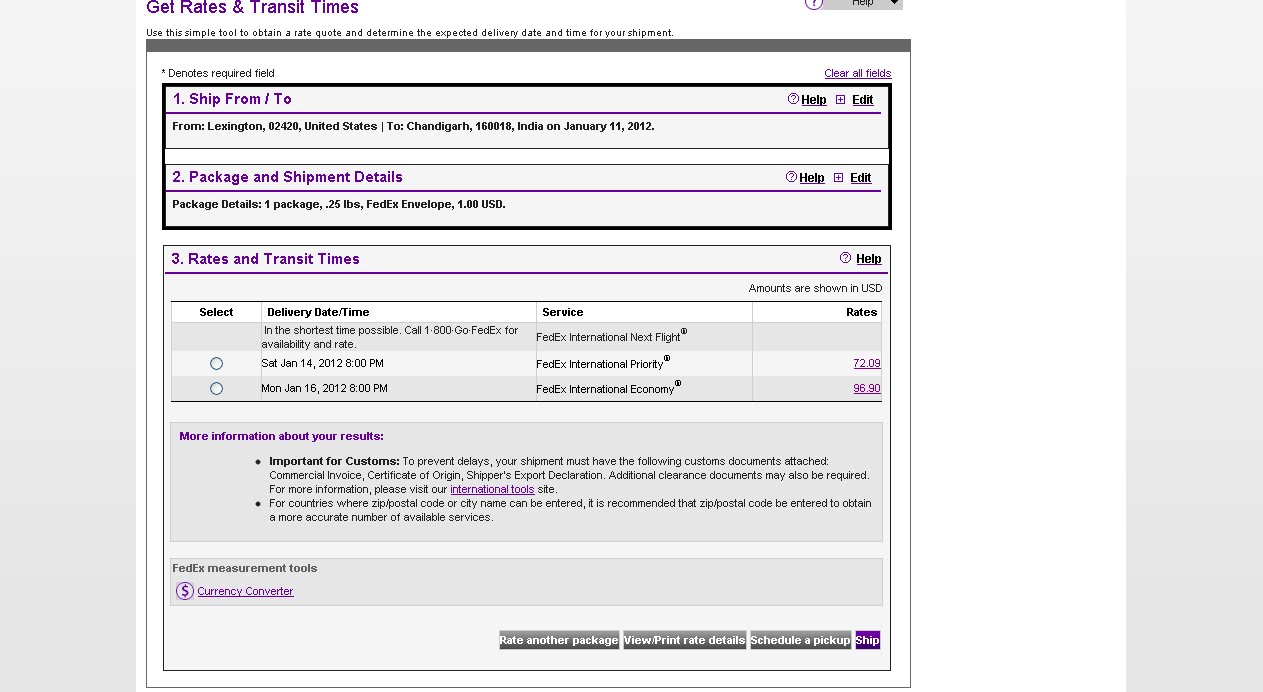
Strange Fedex pricing and opportunity


I had to ship a set of important documents to India. I opted to go with Fedex due to its brand. First thing that surprised me was how expensive it is still to ship a few pages of documentation to India from the US. I had to shell out close to 70 USD just to ship a few pages.

What as even more surprising is the quote that i got for 2 options. These are shown in the screenshot above. Did you notice ? The price for faster delivery is lower than the slower alternative.

It is hard to understand the rationale. One possibility is that fedex incurs inventory cost associated with all the packages in transit. I'd have to assume that if that is the logic the it should apply to larger packages which actually take up significant physical space.

Most likely it is a bug in the software.

Tuesday, December 28, 2010

air france - cost of software glitch

Our problems with Air France started with a strange bug in their reservation system, which seems to discriminate against or deny the existence of infants between the age of 1 and 2 years. The screen shot below is from Air France on-line reservation web site. If you notice (as i did to my astonishment) there is no way to enter a 18 month old traveller.


Now I thought this might be just user inteface glitch limited to the online portal. I was sadly mistaken. The web support personnel who tried to help me in getting my daughter booked on that flight also met with stiff resistance from the software system. It was not just the user interface but someone had, quite cunningly, designed the system in a way that it could not accept birth-dates for 1-2 year olds. It took 2 full days of backroom negotiations to override the deeply embedded digital conspiracy. It was then that i realized the true cost of a software bug


A back of the envelope calculation would be to multiply the number of 1-2 year olds traveling per year with customer support cost of 4-16 hours per traveling infant. Now Air France KLM together carry close to 70 million passengers per year. If we take ages of the passengers to have a uniform distribution we are talking close to a million 1-2 year olds each year. If we take average hourly wage of customer support staff at $20 per hour then we are looking $80-$320 per child. This translates to $80-$320M in customer support cost for Air France each year. Not something to sneeze at !!

Now arguably, there are many factors that may cause this to be lower amount like there may be just 0.25 million 1-2 yr olds flying each year as the age based distribution of the airline may not be uniform (say normal distribution with low standard deviation).

Some would also argue that this only applies to internet based booking but as I had pointed out earlier the glitch ran deep into the other software being accessed by other people like airline staff and hence arguably will effect every mode of booking at some stage requiring costly intervention.

It has been more than a month since this glitch has been there and hasn't been fixed yet.

Sunday, August 29, 2010

Google must respond and plug this leak!!

Here I had described a surprising behaviour from Gmail. The bottom line here was that Google was using knowledge about my work email address which was configured in gmail as a backup address ( I will cover this in a different post when i have some time), in ways that can be clearly construed as a breach of privacy boundaries and at the very least as very unusual behaviour.

Quick recap - I had sent a calendar invite from my work address to someone at a fairly well known startup. The response to that calendar invite was automatically forwarded to my gmail address and my gmail address was exposed to all the people on this invite list without my consent. This is a clear breach of privacy. The reason for providing additional email addresses to an email provider are -

1. For forwarding emails to another address
2. For recovering account information in case one forgets his/her account information

To use this information in a way that exposes more information than i seek to share with others, is a clear breach of my privacy. Google must plug this leak. There are a lot of other dangerous possibilities once a service provider tries to stretch functionality that spans natural boundaries like professional life and personal life. It is critical that each function that spans these natural boundaries is evaluated for inadvertent or intended privacy abuse.

For example, assuming Gmail allows me to configure multiple mail forwarding addresses for specific kinds of rules (which it does). I may want to forward emails related to a specific topic to my wife. This will require me to add my wife's email address as one of the email addresses in my gmail account. My wife will actually confirm this as we'd have discussed this offline. Now if this acceptance is used to construe (mis) that both these email IDs are mine, i may start to receive calendar invites sent out by my wife from her email account. My gmail experience is just a step away from this possibility.

Calendering conflicts in today's world span personal and professional commitments and hence Google is trying to deliver functionality that allows you to keep your gmail calendar with your work calendar. But these are boundaries that need to be tread very carefully. We, the consumers, cannot leave this responsibility solely to Google and must raise concerns everytime we come across an interaction with Google or similar companies that don't look correct. This is the age when, consumers have to be doubly vigilant. It is hard to not provide information as you seek functionality but policing the usage of that information must be done by consumers.

Google must respond to this !! If you have experienced similar issues with other sites/providers please post it in the comments here so that we can investigate and raise awareness of these issues.

Friday, August 20, 2010

1-800-NO-SOFTWARE

Do you know which company has this as their 1800 number ? It is incredible to see a vision run so deeply into a company. Right from taking on CRM as the ticker symbol to this number as the customer support number, it communicates a fanatical pursuit of vision. When coupled with fantastic technical and business execution, these steps create religious fervor in employees and  mortal fear in competition.

An achievable binding vision set by a credible leader is worth its weight in gold. Salesforce continues to amaze me with its bold moves. The ability to drive a large organization with such optimisim in a highly complex technology environment takes a lot of courage. There seems to be a healthy skepticism for the word "impossible" at Salesforce.

I am looking forward to other bold moves by Salesforce to further encourage adoption of their Force.com platform. Spring partnership certainly addresses the Java application platform issue to a great degree. But every application and application developer has been using relational databases especially Oracle for a long time now and is likely to resist moving to Salesforce PaaS for generic applications as it has a different datastore. Same goes for Google App Engine. The most likely applications, in the current form, will be extensions/customizations around Salesforce data.


PaaS providers face this problem. IaaS providers like Amazon have a complete suite of offerings around traditional RDBMS products sand are seeing a quicker adoption of their services. It is critical that PaaS providers make it easier for people to port their current applications to PaaS provider without too much rework. Right now PaaS providers are hoping that new applications that are developed will be developed on their platform. This strategy may work but may not achieve critical mass of usage fast enough.

Tuesday, August 17, 2010

CDNs - the rise of the anticloud

I was at a meeting with Akamai the other day. Akamai is a very fascinating company and i have followed both their business and technology progress quite closely. in fact, I have made money on their stock. Akamai has been delivering services in the Cloud business model for longer than the term Cloud has been in existence. In a strange way, though, I consider them anticloud. They are a force driving decentralization of content while Cloud is the force of centralization of both content and processing. In many ways Akamai is stretching the boundaries of the Cloud to the edges and in an extreme situation right to the home. This extreme situation is when CDNs merge with P2P technologies to deliver content from the end points themselves. Now, if anybody thinks this is hypothetical and fantasy then, look at Red Swoosh acquisition by Akamai. What P2P lacks, arguably, is the content management sophistication of traditional CDNs but companies like Akamai see no reason why the management cannot be extended to a content delivery node sitting on any of home network devices viz., wifi router, broadband router, set-top box etc.

In principle, this may allow some users to become data center providers for their community where the service is delivered by Akamai through its partners but the real estate is rented from end-users who make the capital investment into buying bigger network devices.

The forces pushing the content to the edges are not new - network congestion which gets exacerbated by rise of video. Today's digital video is not your father's video content. It is much bigger in resolution, higher in frame rates, interactive, 3D etc. All these factors demand data capacity of unprecedented levels. A 4K video (which you can upload on youtube now and is actually a resolution of 4096x3072) will not take a lot of simultaneous viewers to clog the internet backbone. Through the history of the internet, the last mile has been the bottleneck but with the advent of video the rate limiting characteristic of the last mile is preventing the meltdown of the internet. Thank god, we don't have all the internet users on broadband !! It is easy for people who have seen Indian cities transform in last 10 years to relate with this. The prosperity has resulted in explosion of car ownership but the roads have failed to keep pace and result is massive traffic jams.

It is no surprise that Cloud providers are launching or looking to launch their own CDNs. It is not easy though to build out POPs across the globe even for large companies. For video the Cloud will be distributed and stretched to include the homes. It is the management of content that will be Cloud based but the data is more likely to reside on the edges. Microsoft has over a period of time has moved away from using Akamai and Limelight networks to owning CDN assets on the edges and Azure CDN i believe is totally MSFT owned now.

Things are getting really interesting in this space and it may be time to go long on Akamai again but at $40+ it is a little too high for me.

Wednesday, May 5, 2010

Strange use of my profile data on Gmail…….

Yesterday I sent out a calendar invite to the CTO of a well known cloud computing startup. When I view the response on Outlook on my PC, I see the acceptance email addressed to my Gmail address.


The acceptance email from this person on my iPhone was addressed to a friend of mine. On iPhone when I click on this friend’s name on the “to” field I see his Gmail address and my Gmail address in the details about my friend.

Now all this is very confusing because I sent my calendar invite from my work email and not Gmail. There is a connection though, I have set my work email as the forwarding address for the emails that I receive on my Gmail that match a set of filter criteria. More specifically, I have Google Alerts directed to my Gmail account and I forward those alerts to my work email address. Another important fact is that this startup Company is using Gmail for their corporate email.

So it is clear that when I send a calendar invite from my work email account to the personnel of this company it hits the Gmail servers. Gmail at that point is using my work email address to look up my personal Gmail account and is sending the responses to both my work email and my Gmail account. This is a big data privacy and security issue. When enterprises worry about moving their applications and data to the Cloud it is these kinds of leaks (inadvertent or otherwise) that they fear and rightly so.

In the traditional IT model, the likelihood of such events is low as there is clear physical and ownership separation of my personal data and my enterprise data. Google has a natural desire to maintain a single identity across all my aliases/accounts, which may or may not be a desired state for me. The massive analytics infrastructure operates across all data regardless of their ownership/tenancy boundaries.

While this may allow Google to offer valuable products and services to me, like highly personalized search results and recommendations, it exposes more information than I am comfortable disclosing and worst of all I don’t even fully understand what it might expose. This is a small but illustrative example that shows why it is imperative that enterprises follow the model of “trust but verify” with Cloud providers when engaging them. Cloud providers must share and expose their architectural details for 3rd party audit. There may be a case for identifying functions that are more prone to creating privacy/security risks like analytics which by design are meant to extract identifiable information from a large data sets regardless of tenant boundaries. These functions and their output data access should be controlled and controls should be made transparent. In fact, enterprise tenants should be able specify and verify what functions are allowed with specific data - like analytics. Consumers have little leverage with large Corporates since we consumers value the functionality delivered by these companies far more than the potential loss of privacy/security so we are unlikely to vote with our mouse clicks.

Wednesday, March 10, 2010

my iPhone mail and calendering application has a bug

I showed up exactly 3 hours late for a meeting. I was traveling from East Coast to the West Coast. Two things happened. Actually one happened and one didnot. My iPhone time automatically changed to PST. But, the calendar was still operating on EST as it requires an explicit change of zone.

Now things get interesting as the alerting functionality was picking up the time from iPhone time. So i was getting alerts for a personal reminder i had set at 10.00 EST each day at 10.00 PST. For some reason I did not notice this error. I think the reason is that time zone shift hadn't happened totally in my mind. For this particular reminder I actually did want to be reminded at 10.00 AM local time and that is what i was getting so I didnot find anything amiss. In fact, this behaviour lulled me into thinking that all was correct.

A consistent and correct solution is for all the functions in email and calendering appplications (and all linked applications) to pick time and zone data from a single source. If there are multiple sources user should be warned about conflicts.

Note to self, always manually change the time zone or switch the time zone support to "off"

Sunday, February 21, 2010

Privacy, complexity seen as Google blind spots - Says SFGate

This link has the article talking about Google blind spots.

I have talked about complexity here around an year back. When I have some more time at hand I should elaborate.......

Wednesday, February 3, 2010

Ode to February

It fell short of expectations
Perched amongst peers
In a highly inconspicuous place
Every four years it leaps
Reaches out in vain
Catch up, it can't
Tired, it rests
Performing a vital but undistinguished role
Waiting for yet another time

Tied to the cosmic order like
None of its peers
It's unique
It's persistent
It's a reminder of a nuanced reality
It's everything some of us aspire to be
Live, do, have a deeper meaning, persist
It's February - the month of my birth
I embrace what it represents.

Vijay

Friday, July 31, 2009

UX my latest interest

The world of UX is truly mesmerizing. I have been defining software products over for many years, especially in the enterprise domain. But, the innovations being brought by web 2.0 client-side technologies are changing the face of UX design. In fact, UX designers are the product and brand managers of the past merged into one with an additional responsibility of actually executing on the visual aspects using widely available tools.

In last couple of months, I have found great tools to give effect to my UX visualizations ranging from firefox plugins like Pencil Project, Powerpoint to using Jquery and its plugins. The journey gets more and more interesting as I get better with the tools available.

Amongst the IT professionals, traditionally, client side functions have been treated with disdain by the server side guys. In recent years this paradigm has been turned on its head with a new found realization in businesses that in the Internet world UX is what makes or breaks a service or product.

It is great to be building a service and picking up skills on the way. The journey is great and with the end result looking more promising with each day, i couldn't have asked for more.

Monday, May 18, 2009

Google's demise - a possible theory

History has shown that nothing is eternal and every real and abstract construct goes through the cycle of birth and death. I understand that this statement lacks a formal argument chain that makes it susceptible to ridicule by a lot of people. But I urge everyone to humor me as, while this is what made me think about topic, it is not the central theme of this post.

The above-mentioned belief made me start to look at the forces that may cause Google's downfall. In addition, to the belief stated above, I have been noticing that Google services are having outages that are getting progressively more conspicuous, even though the availability statistics might be getting better. I just faced ( 9.00 AM EST May 18 2009) a news.google.com ( 503 Server error). This is on top of an outage reported just yesterday.

I recently heard a talk on fall of civilizations and one of the themes highlighted was that the cause for a civilization's failure is, often, the reason the civilization was successful in the first place. Arguably Google's success in large parts can be attributed to the presence of an extraordinarily large number of extraordinarily smart people. They have built a large, proprietary and hugely sophisticated system that is, possibly, unparalleled in its complexity in the modern business world. It is similar to the financial markets in its complexity which have been made complex due to an intricate web of really complicated financial instruments. Even the smartest of people with enormous talent could not stop the systemic failure in the recent financial crisis. If anything at all the smarts, arguably, contributed to increasing the risk of a systemic failure.

I believe that Google is susceptible to the risk posed by complexity of its ever evolving system. This system will continue to demand, more and more, high-horsepower intellect which will continue to become increasingly difficult to attract over time due to various competitive pressures and Google's waning charms. I hear that, already, Google search algorithms take over 600 signals to rank search results. While most of us view this as formidable IP that is hard for anyone to replicate and better, I believe that there is a risk of this beast becoming increasingly elusive to the core team at Google, which will start to affect its quality.

If I were Google, I'd employ some of the smarts to look at this specific risk - the risk of failure due to increasing systemic complexity. In my experience, Google is unique in bringing such sophistication to the consumer space while dealing with phenomenally quick changes in the problem space. One can argue that sending a space ship to the orbit is a more complex enterprise. I will not argue the complexity of the system. The competitive and problem dynamics, though, are relatively static, allowing engineers to design for a relatively unchanging problem space. The complexity dimension of the problem is not amplified by competitive and problem-space dynamism.

Google doesnt have that luxury. Taleb views efficiency as form of leverage. I'd extend that to include complexity as a form of leverage and hence a contributor to risk.

Wednesday, March 25, 2009

Ishaan's bipartisanship

For days now Ishaan, my 4 year old son, has been insisting on sending one of his crayon-drawn masterpieces to Barack Obama. Just after he finished putting one of these into the envelope with the White House address, he asked me if I remembered John Mccain - Barack Obama's old friend. I said "Yes, sure". He said he wanted to send one to John Mccain as well as he hadn't received any of his cards yet. So now I have 2 fat envelopes for BO and JM with their addresses ready to be sent to DC.

It was the purest act of bipartisanship I have witnessed, till date. This is the change we can believe in !!

Wednesday, February 4, 2009

accuracy and precision

The other day I was, yet again, explaining the difference between accuracy and precision to someone. I was explaining how John Doe was precisely inaccurate in his assertions. The image below (borrowed from statistics lessons in the past) illustrates this difference well.

Sunday, January 25, 2009

identity of spiderman revealed!!!


Let me give you a close up for some clues............


Still wondering who ??